
Every setting on Standard
Use the site as written. Standard Survival is the preset a new game opens on and the baseline behind every page here: $1,000 for Wage Slave, 10 hours of prep, 1× on everything a location holds and 1× on zombie damage. You do not need this page again until you move a slider.
Something set harder
Convert before you plan. Money is your character’s own starting money multiplied by the Starting Funds percentage, so Wage Slave on Scarce shops with $400 rather than $1,000. The one conversion the site does for you is loot: pick your Exploration Resources level at the top of the locations list and every item count and Satiety total on that page rescales. Nothing rescales for the 2 settings the game states in words, so a harder Survival Consumption leaves every food figure here optimistic by an amount no table publishes.
Something set easier
The plans written for Standard gain slack rather than changing shape. On Very Long the window is 13 hours instead of 10 hours, which covers 6 prep shops in travel alone rather than 5, so the trip order in the prep window stops being a hard choice. On Plenty the same shopping list leaves $500 in change. Read the site’s numbers as a floor and spend the surplus on what you skip on Standard.
See every setting and level in the characters list All six settings with the game's wording for each of the four levels, the default preset's level highlighted, and the presets.
Difficulty is one of the five things that change an answer on this site, and the only one you set once and cannot revisit. 4 of the 6 settings carry a figure the game states plainly enough to apply to a number. The other 2 are described in words and nothing more, which is worth knowing before you assume a page has accounted for them.
What each setting multiplies
| Setting | Level | What the game says | Applied figure |
|---|---|---|---|
| Starting Funds | Plenty | Starting funds +50%. | 1.5× starting money |
| Standard | Starting funds unchanged. | 1× starting money | |
| Tight | Starting funds -30%. | 0.7× starting money | |
| Scarce | Starting funds -60%. | 0.4× starting money | |
| Prep Time | Very Long | Pre-disaster preparation time +3 hours. | 13 hours |
| Standard | Pre-disaster preparation time unchanged. | 10 hours | |
| Short | Pre-disaster preparation time -1.5 hours. | 8 hr 30 min | |
| Very Short | Pre-disaster preparation time -3 hours. | 7 hours | |
| Survival Consumption | Lenient | Reduced consumption, faster Life regeneration | none published |
| Standard | Consumption remains unchanged | none published | |
| Strict | Increased consumption, Life regeneration halved | none published | |
| Brutal | Greatly increased consumption, Life no longer regenerates | none published | |
| Zombie Horde Intensity | Weak | Zombie damage -50%. | 0.5× zombie damage |
| Standard | Zombie horde intensity unchanged. | 1× zombie damage | |
| Strong | Zombie damage, HP, and numbers +25%. | 1.25× zombie damage | |
| Very Strong | Zombie damage, HP, and numbers +50%. | 1.5× zombie damage | |
| Extreme Weather | Rare | Extreme weather greatly reduced. | none published |
| Standard | Extreme weather unchanged. | none published | |
| Frequent | Extreme weather more frequent. | none published | |
| Extreme | Constant extreme weather. | none published | |
| Exploration Resources | Abundant | 30% chance to find double the amount of each supply item. | 1.3× loot |
| Standard | Exploration rewards unchanged. | 1× loot | |
| Rare | 25% chance for each supply item to not appear. | 0.75× loot | |
| Very Rare | 50% chance for each supply item to not appear. | 0.5× loot |
The four figures do not compare with each other. Two scale a stock you are handed once and never get again, one scales a clock, and one scales a rate that runs for 100 days. The sections below put each on its own terms, and the worked examples put three of them on a single one.
Starting Funds multiplies the character, not a fixed purse

The game states Starting Funds as a percentage, and the percentage lands on the money the character you picked already starts with. Those bases differ before the slider does anything: Wage Slave $1,000, Student $1,500, Warehouse Manager $1,200. So the same level moves a different amount of money depending on who you took.
| Level | Multiplier | Wage Slave | Student | Warehouse Manager |
|---|---|---|---|---|
| Plenty | 1.5× | $1,500 | $2,250 | $1,800 |
| Standard | 1× | $1,000 | $1,500 | $1,200 |
| Tight | 0.7× | $700 | $1,050 | $840 |
| Scarce | 0.4× | $400 | $600 | $480 |
The spread across that table is the whole of what the setting decides: $2,250 in the top corner against $400 in the bottom, a factor of 5.6. Pages that quote a starting figure, including which character to pick and the prep window, quote the Standard row and expect you to apply the multiplier in the second column.
Prep Time buys trips, and trips come in whole numbers
Prep Time adds seconds to one countdown or takes them off it, and the countdown is spent mostly on travel. A round trip to the nearest prep shop costs Wage Slave 40 min and the furthest costs 3 hours, so what the setting really decides is how many shops fit.
| Level | Window | Against Standard | Nearest shops that fit |
|---|---|---|---|
| Very Long | 13 hours | +3.0 h | 6 |
| Standard | 10 hours | baseline | 5 |
| Short | 8 hr 30 min | -1.5 h | 5 |
| Very Short | 7 hours | -3.0 h | 4 |
The last column is a ceiling and not a plan, because it spends nothing inside a shop. The prep window works out what you actually get on Standard, which is fewer. What the table is good for is where the steps land: Short costs 1.5 hours and no trips, while Very Short costs 3.0 hours and a whole trip on top. The setting does not move smoothly.
Exploration Resources is the one that moves a run
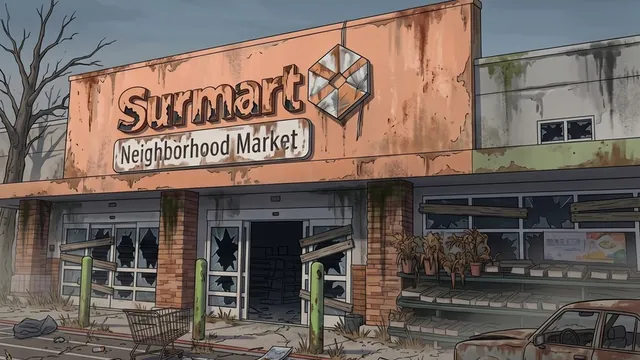
The game words this setting as a chance rather than a multiplier, and across enough items the two are the same thing. Abundant doubles a find 30% of the time, which comes to 1.3× over a shelf. Very Rare removes an item outright 50% of the time, which comes to 0.5×.
| Level | Multiplier | Deserted Supermarket | All 4 sites | Days of food |
|---|---|---|---|---|
| Abundant | 1.3× | 1,693 Satiety | 4,451 Satiety | 93 |
| Standard | 1× | 1,302 Satiety | 3,424 Satiety | 71 |
| Rare | 0.75× | 977 Satiety | 2,568 Satiety | 54 |
| Very Rare | 0.5× | 651 Satiety | 1,712 Satiety | 36 |
Read the last column as a yardstick and not as a stockpile. It is one pass of everything edible the 4 sites can turn up, divided by the 48 Satiety Wage Slave burns a day. The sites restock, so a run gets more than one pass, and no bag carries a pass in one go. What the column is good for is the gap between rows: dropping from Standard to Very Rare costs 36 days of that yardstick, and nothing else on the screen costs anything close.
The locations list applies the multiplier for you. Pick your level at the top of the page and every item count and Satiety total rescales, so where to scavenge and what a location restocks stay true on any setting.
Open Deserted Supermarket in the locations list The site's own row, with what it holds and what a trip there costs. Set your Exploration Resources level at the top of the page and the count on this row moves with it.
Zombie Horde Intensity is a rate, not a pool

The published figure is a multiplier on zombie damage. The heaviest attacker any scheduled crisis sends is the Zombie (Mutant), at 8 damage every 4 seconds.
| Level | Damage multiplier | Damage a second | What the game says |
|---|---|---|---|
| Weak | 0.5× | 1.00 | Zombie damage -50%. |
| Standard | 1× | 2.00 | Zombie horde intensity unchanged. |
| Strong | 1.25× | 2.50 | Zombie damage, HP, and numbers +25%. |
| Very Strong | 1.5× | 3.00 | Zombie damage, HP, and numbers +50%. |
Your side of that exchange does not move. Titanium Door is 4,000 effective hit points at $100 on every setting, so the slider is felt entirely as how quickly the pool drains. The two hardest levels also raise zombie health and numbers, which the game says in the same sentence as the damage figure, and no multiplier is published for either. So the honest reading is that those levels cost more time at the door than the damage column on its own suggests. Doors and windows sizes barriers, and what comes through the door has the schedule.
The two settings the game states in words

Survival Consumption and Extreme Weather carry no figure this site can apply. The game describes their levels, and that description is the whole of what is published.
| Setting | Level | What the game says |
|---|---|---|
| Survival Consumption | Lenient | Reduced consumption, faster Life regeneration |
| Standard | Consumption remains unchanged | |
| Strict | Increased consumption, Life regeneration halved | |
| Brutal | Greatly increased consumption, Life no longer regenerates | |
| Extreme Weather | Rare | Extreme weather greatly reduced. |
| Standard | Extreme weather unchanged. | |
| Frequent | Extreme weather more frequent. | |
| Extreme | Constant extreme weather. |
What each one acts on is published, which is the next best thing. Survival Consumption moves the daily bill. Wage Slave spends 48 Satiety a day on Standard and every food figure on this site is priced against that number, so the five survival stats is where the drain per character sits. Raise the setting and the bill rises by an amount nothing states. Treat the stockpile figures here as a ceiling and leave margin.
Extreme Weather moves a calendar. The forecast in the data is a fixed 100 days carrying 7 cold ones, and the hundred day forecast reads it day by day. Nothing published says which of those days a harder setting adds or a gentler one removes, so the forecast pages are exact on Standard and directional elsewhere.
The presets are combinations, so read the row

| Setting | Fully Stocked | Standard Survival (default) | Potential Peril | Supply Shortage | Under Siege |
|---|---|---|---|---|---|
| Starting Funds | Plenty | Standard | Standard | Tight | Plenty |
| Prep Time | Very Long | Standard | Short | Very Short | Very Long |
| Survival Consumption | Lenient | Standard | Standard | Strict | Standard |
| Zombie Horde Intensity | Weak | Standard | Strong | Very Strong | Very Strong |
| Extreme Weather | Rare | Standard | Frequent | Extreme | Frequent |
| Exploration Resources | Abundant | Standard | Standard | Rare | Standard |
Supply Shortage puts every one of the six settings above Standard and is the only preset that does. The one worth reading carefully is Under Siege: it sets 2 settings harder and 2 easier, which makes it a gentler start than Standard on money and hours and the worst on the screen for what arrives at the door. Only 2 of the 5 presets move Exploration Resources at all, and that is the setting the next section shows doing the most work.
Worked examples
What a preset is worth in days of food
Money and loot both end up as Satiety, so they go on one scale. The best value on a shelf is White Sugar at 2.5 Satiety a dollar, and Wage Slave spends 48 Satiety a day. That turns a purse into days, and the loot multiplier turns the map into days on the same basis.
| Preset | Starting money | Days from money | Days from the map | Both together |
|---|---|---|---|---|
| Fully Stocked | $1,500 | 78 | 93 | 171 |
| Standard Survival (default) | $1,000 | 52 | 71 | 123 |
| Potential Peril | $1,000 | 52 | 71 | 123 |
| Supply Shortage | $700 | 36 | 54 | 90 |
| Under Siege | $1,500 | 78 | 71 | 149 |
On Standard Survival the shop and the map together come to 123 days against a 100 day run, and that margin is what the whole site is written inside. On Supply Shortage it is 90, short of the run before you have spoiled a single tin, which is why cooking and farming stop being optional on that preset. Which food system first is the page that decides which of them you build.
The column also names the presets that cost you nothing to eat. Potential Peril comes out on the same 123 days as Standard Survival, because it leaves Starting Funds and Exploration Resources where Standard Survival has them. What Potential Peril costs you is time at the door and hours in the prep window, which this table does not price.
Two warnings on the table. It assumes you buy nothing but White Sugar, which no real run does, because Morale runs on variety and a bag holds only so much; food and Satiety ranks the alternatives. And it counts one pass of each site while the sites restock. Use it to compare presets against each other, not to plan a stockpile.
What the same slider is worth to different characters
Starting Funds at Scarce takes $600 off Wage Slave and $900 off Student, whose entries in the characters list carry the starting money each level is a percentage of. In days of food that is 31 days against 47. The percentage is identical and the loss is not, so a hard funds setting is a different decision depending on who you took.
What three hours of prep costs
Going from Standard Survival to Very Short removes 3 hours, which is 30% of the window. In travel alone that is the difference between 5 shops and 4, and the one you lose is the furthest, which is 3 hours of travel on its own. Going the other way, Very Long adds 3 hours, brings the last shop back into reach, and still leaves 2 hr 20 min for the shelves.
What to do
- Leave the preset on Standard Survival for a first run. Every figure on this site assumes it, so the numbers work as written.
- Change one slider at a time after that. The 6 are not comparable with each other, and a preset moves several at once.
- Raise Zombie Horde Intensity before Exploration Resources if you want a harder run that still feeds itself. Very Rare costs 36 days off the map yardstick; Very Strong costs time at the door and nothing off the shelves.
- Pick your Exploration Resources level at the top of the locations list before you plan a route. Every count there is Standard until you do.
- Apply the Starting Funds multiplier to your character’s own starting money rather than to $1,000. The 3 playable characters begin with $1,000, $1,500, $1,200.
- Leave margin on food if you raised Survival Consumption. Nothing published says how much the daily bill rises, so there is no sum to do, only room to keep.
Quick reference
- Default preset: Standard Survival, all 6 settings on Standard.
- Starting money: a multiplier on your character, Plenty 1.5×, Standard 1×, Tight 0.7×, Scarce 0.4×.
- Prep window: Very Long 13h, Standard 10h, Short 8.5h, Very Short 7h.
- Loot multiplier: Abundant 1.3×, Standard 1×, Rare 0.75×, Very Rare 0.5×.
- Zombie damage: Weak 0.5×, Standard 1×, Strong 1.25×, Very Strong 1.5×.
- No published figure: Survival Consumption and Extreme Weather.
- Hardest preset: Supply Shortage, 6 of 6 above Standard.
- The mixed one: Under Siege, 2 settings easier and 2 harder.
- Biggest single change: Exploration Resources, worth 36 days of the map between Standard and Very Rare.